
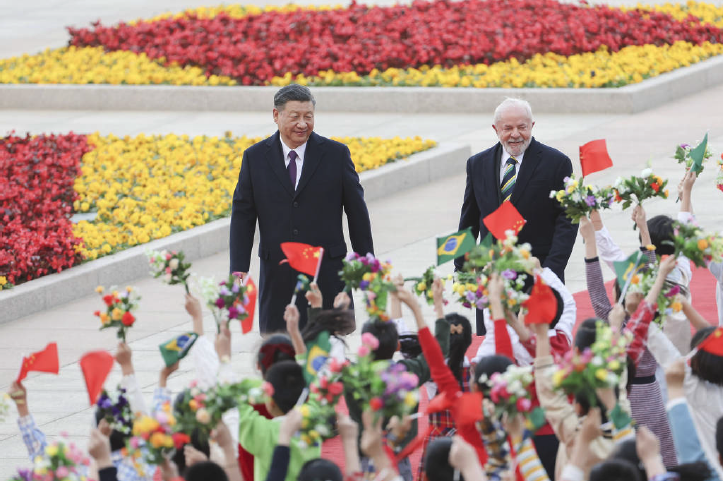
In an article for Folha on the eve of the G20 summit, Chinese leader Xi Jinping highlights partnership in various areas and says it's necessary to reform the IMF, World Bank and WTO16.Nov.2024 at 11:00 pm
PRINT EDITION: (https://www1.folha.uol.com.br/fsp/fac-simile/2024/11/17/)
Xi Jinping
President of the People's Republic of China
At the invitation of President Luiz Inácio Lula da Silva, I will shortly be paying a state visit to the Federative Republic of Brazil and taking part in the G20 Leaders' Summit in Rio de Janeiro.
Brazil has a vast territory, rich resources, breathtaking landscapes, diverse cultures and is a country that the Chinese people love. More than 200 years ago, tea, lychee, spices and porcelain crossed the seas to Brazil. This created a bridge of economic and commercial exchange between the two countries and the bonds of friendly exchange between Chinese and Brazilians were born.
China-Brazil diplomatic relations, established on 15 August 1974, have withstood the changes and turbulence in the international situation over the past 50 years and are increasingly mature and dynamic. They have effectively promoted the development of both countries, made a positive contribution to peace and stability in the world and offered an example of win-win co-operation and a shared future between two major developing countries.
China and Brazil have always insisted on mutual respect and equal treatment. They understand and support the development paths that the Chinese and Brazilian people have chosen. Brazil was the first country to establish a strategic partnership with China and the first country in Latin America and the Caribbean to establish a global strategic partnership with Beijing.
The two countries have a relationship that has always been at the forefront of relations between China and developing countries and have complete governmental mechanisms for dialogue and cooperation. The Sino-Brazilian High-Level Concertation and Co-operation Commission (Cosban), which has been running smoothly for 20 years, plays an important role in co-ordinating and planning co-operation in different areas and in the pursuit of common development.
China and Brazil always persist in mutual benefits, shared gains, complementarity, and jointly promote the modernisation of both countries. China has been Brazil's largest trading partner for 15 consecutive years and a major source of foreign investment - according to Chinese statistics, it has imported more than US$ 100 billion from Brazil annually over the past three years, setting a new record. With joint efforts, the two countries enjoy an ever-improving bilateral trade agenda, ever-higher quality co-operation and ever-expanding common interests. Their mutually beneficial co-operation in areas such as agriculture, infrastructure, energy and natural resources, green development, science, technology and innovation, finance, among others, is effective and full of highlights and offers vigorous impulses to the economic and social development of both countries.
China and Brazil have always persisted in openness, inclusion and mutual learning. By nature, they feel close to each other and have a common quest for all that is beautiful. The fact that Cecília Meireles and Machado de Assis, both well-known Brazilian poets and writers, translated poems from the Chinese Tang dynasty reflects a mental symphony between the two sides that transcends time and space. In recent years, music, dance, gastronomy, sports and the arts have become the new bridges linking the two peoples and contributing to the deepening of mutual knowledge and friendship between Chinese and Brazilians.
Cute capybaras, bossa nova, samba and capoeira are popular in China, while traditional festivals such as the spring festival and other elements of Chinese culture such as traditional medicine are becoming increasingly familiar to Brazilians. Between the two countries, there are frequent interactions between young people, journalists and academics, as well as dynamic exchanges between sub-national entities. What's more, the activities to celebrate the 50th anniversary of the establishment of diplomatic relations serve as banquets of cultural delights offered to both peoples. In recent days, I have received letters from more than a hundred Brazilian friends from the Brazil-China Friendship Association, Brazilian universities, Rio's Copacabana Fort Orchestra and other sectors of Brazilian society, and I have been very touched by the great expectations they have for deepening Sino-Brazilian friendship.
China and Brazil have always persisted in peaceful development, impartiality and justice and have identical or convergent views on many international and regional issues. Both countries are firm defenders of multilateralism and the basic norms governing international relations and have maintained close collaboration throughout this time on important issues such as global governance and climate change in international organisations and multilateral forums such as the UN, the G20 and BRICS.
Earlier, China and Brazil issued common understandings on a political resolution to the crisis in Ukraine and received a positive response from the international community. Hand in hand, the two countries are fulfilling their roles as responsible major countries, promoting global multipolarisation and the democratisation of international relations, as well as injecting positive energy into world peace and stability.
In today's world, transformations on a scale unseen in a century are taking place at an accelerated pace, and new challenges and changes continue to emerge. A Chinese saying goes: "In a boat race, those who row hard win; in a sailboat race, those who dare to advance under full sail win." China and Brazil, two large developing countries in the eastern and western hemispheres and important members of the BRICS, must unite more closely, dare to be pioneers and wave chasers, and together open up new sailing routes that lead to a more beautiful future that the peoples of the two countries and humanity deserve.
We must maintain friendship as the general direction for the development of the relationship between China and Brazil. We will always persist in mutual respect, trust and learning and further strengthen exchanges between governments, between political parties, between legislative bodies at all levels and in all areas. We will reinforce exchanges of governance and development experiences, consolidate mutual strategic trust and further compact the political base for Sino-Brazilian relations. We will continue to take advantage of the role of cooperation mechanisms, such as Cosban and the Global Strategic Dialogue, to form a stable and mature relationship between great countries and promote it in order to move forward with firm steps and reach far and wide.
We must cultivate new strengths for mutually beneficial co-operation between China and Brazil. Both countries have important goals of accelerating economic development and improving people's well-being, and are striving to achieve breakthroughs in modernisation. In the rapidly evolving context of the new round of scientific and technological revolution and industrial transformation, our countries must seize future opportunities. We will continuously promote the strengthening of synergies between the Belt and Road Initiative and Brazil's development strategies, constantly strengthen the strategic, global and creative nature of China-Brazil mutually beneficial cooperation, create more exemplary projects that meet future demands and bring lasting benefits to the people, and boost the common development of our countries and regions.
We must consolidate the friendship between the peoples of China and Brazil. The rich and unique cultures of the two countries inspire and attract each other. We must carry on the good tradition of openness and inclusion, deepen exchanges and co-operation in culture and education, science and technology, health, sport, tourism and between sub-national entities. With this, our peoples can get to know a more genuine, multidimensional and alive China and Brazil, and we will train more "ambassadors" who work for the long continuity of the traditional China-Brazil friendship. With these exchanges, we will ensure that our civilisations live together in harmony, shine together and contribute to the civilisational diversity of our world, which can be compared to a garden full of flowers.
We must demonstrate the unity, mutual aid and responsibility of China and Brazil. Today, the Global South is collectively on the rise, but its voice and aspirations are not yet fully reflected in the system of global governance. As major developing countries, China and Brazil must assume the responsibility entrusted by history and work together with the other countries of the Global South to firmly defend the common interests of developing countries, face global challenges with co-operation, make global governance fairer and more equitable, and contribute to the peace, stability and common development of the world.
Another important objective of my visit to Brazil is to take part in the G20 Summit. The G20 is an important platform for international economic co-operation. Brazil set the motto of its presidency as "Building a just world and a sustainable planet", proactively promoted G20 co-operation in all areas and laid a good foundation for the successful holding of the Summit in Rio. President Lula adopted "fighting hunger and poverty" as a main theme of the summit and proposed the launch of the Global Alliance Against Hunger and Poverty, to which China expresses great appreciation and support.
In order to build a just world, the G20 must persist in the principles of mutual respect, cooperation on an equal footing, mutual benefits and shared gains, and support the countries of the Global South to realise greater development. We need to put development at the heart of G20 cooperation, prioritise the implementation of the UN's 2030 Agenda for Sustainable Development, form a global partnership for sustainable development, and promote more inclusive, beneficial and resilient global development. We must proactively promote reform of the International Monetary Fund, World Bank and World Trade Organisation and increase the representation and voice of the Global South. We must strengthen the coordination of macroeconomic policies, promote the liberalisation and facilitation of trade and investment and create an open, inclusive and non-discriminatory environment for international economic cooperation.
In order to build a sustainable planet, the G20 must advocate sustainable production and life and harmonious coexistence between man and nature. It needs to boost in-depth international co-operation in areas such as green and low-carbon development, environmental protection, energy transition and tackling climate change, persist in the principle of common but differentiated responsibilities, and provide more support to the countries of the Global South in terms of funding, technology and capacity building. Thirty-two years ago, the United Nations Conference on Environment and Development was held in Rio de Janeiro, where key results such as Agenda 21 were achieved. One of the important agendas of the G20 leaders in Rio will be the discussion on green and low-carbon development on the planet. I hope that the summit can inject greater vigour and confidence into global sustainable development.
I am convinced that the G20 Summit in Rio will achieve fruitful results and leave a distinct Brazilian mark on the history of the bloc. I also look forward to working together with President Lula to lead China-Brazil relations into the new "golden 50 years" and form a community with a fairer and more sustainable shared future.